
© 2026. Theme based on Hyde
© 2026. Theme based on Hyde
Computational social science case study
This project studies online support as an interaction: what the original poster appears to need, how commenters respond, and whether the original poster comes back with gratitude, elaboration, questions, or pushback.
Do support responses fit what posters are asking for, and does that fit predict more positive original-poster uptake?
A stratified sample of Reddit post-comment-OP reply units from support and advice communities.
LLM-assisted annotation, human-in-the-loop validation, LIWC checks, and mixed-effects modeling.
Responses often tracked the poster's needs, and better-matched support was associated with OP gratitude and elaboration.
What constitutes successful social support online? Previous work tends to focus on the language of the support-provider and has identified a wide range of factors associated with effective support, including linguistic synchrony (Doré & Morris, 2018), use of specific pronounds (e.g., “you” rather than “I”; Munin et al., 2025; Alghamdi et al., 2025), and templates of empathy, including validation, paraphrasing, and reappraisal (Gueorguieva et al., 2026).
However, when people seek support online, they are not all asking for the same thing: some want advice, validation, sensemaking, or space to disclose emotion. We know less about whether support providers adapt these tactics to what the seeker appears to need, and whether this fit predicts how support is received by the seeker.
Rather than treating social support as a property of one comment in isolation, this project models support as a three-part exchange.
Advice, emotional disclosure, validation, sense-making, high-stakes help, or another support need.
Validation, interpretation, emotional acknowledgment, advice, questions, self-disclosure, or challenge.
Gratitude, elaboration, answering a question, follow-up questions, or pushback.
To model support-seeking and provision in naturalistic conversations. I used human annotation with LLM-assistance: I created a gold set containing the key construct labels and, after validation, used LLM to scale annotation to all 2765 posts/comments.
| Annotation layer | What it captures | Example labels |
|---|---|---|
| Support-seeking needs | What kind of response the original post appears to invite. | Advice, emotional disclosure, validation/appraisal, sense-making. |
| Comment strategies | What the level-1 reply does in response to the OP. | Validation, emotional acknowledgment, interpretation, question, advice, self-disclosure. |
| OP uptake | How the original poster responds when they return to the thread. | Gratitude, elaboration, answering, follow-up question, pushback. |
I used logistic mixed-effects models to test three linked questions: whether support-seeking needs predicted comment response strategies, whether response strategies predicted OP uptake, and whether specific need-response fit indicators predicted OP gratitude or pushback. Where possible, models accounted for clustering among comments within posts and subreddits, with simpler random-effects structures used when needed for stable model fitting.
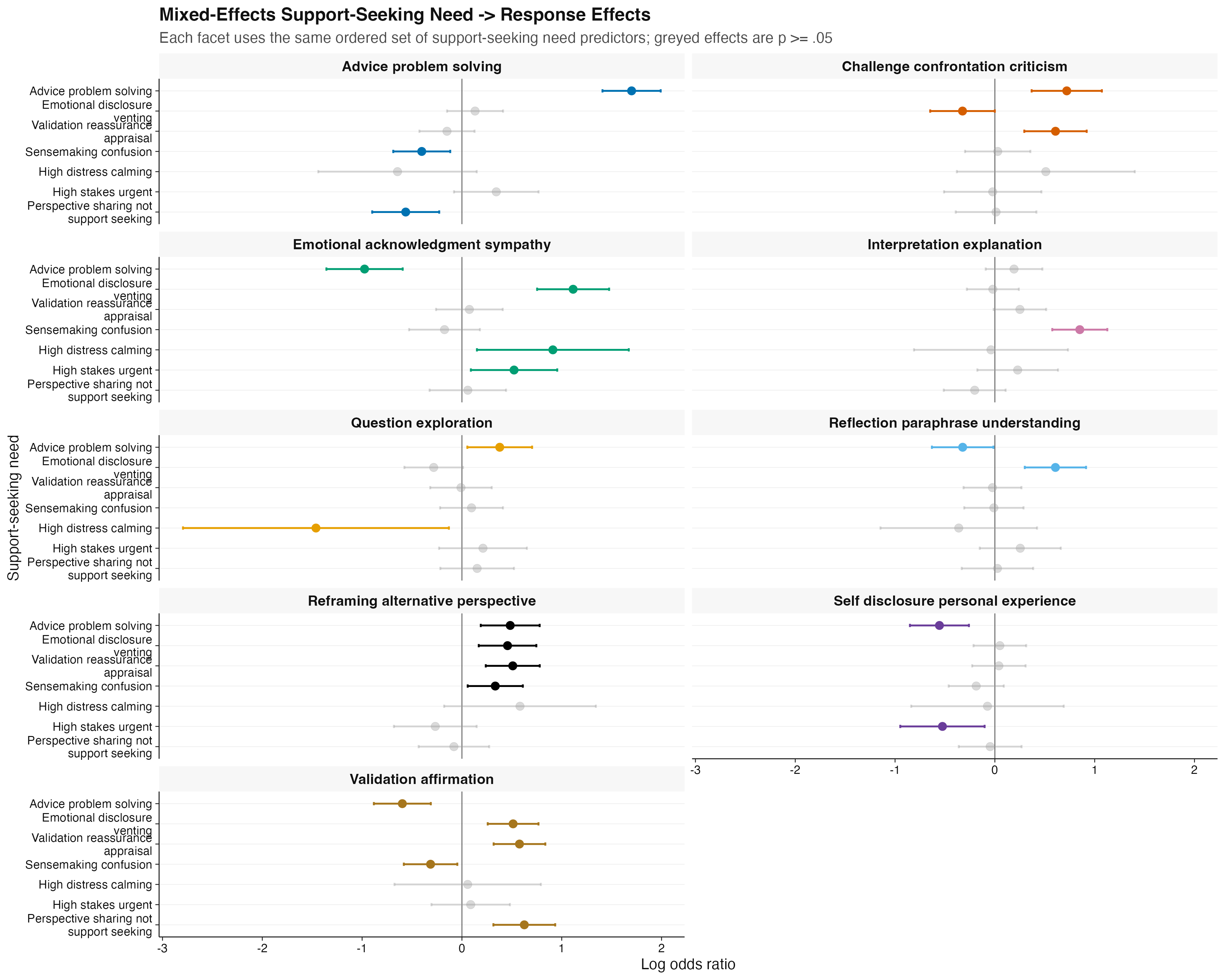
Advice-seeking posts received more advice, emotional disclosure received more acknowledgment and validation, and sense-making posts received more interpretation and questions.
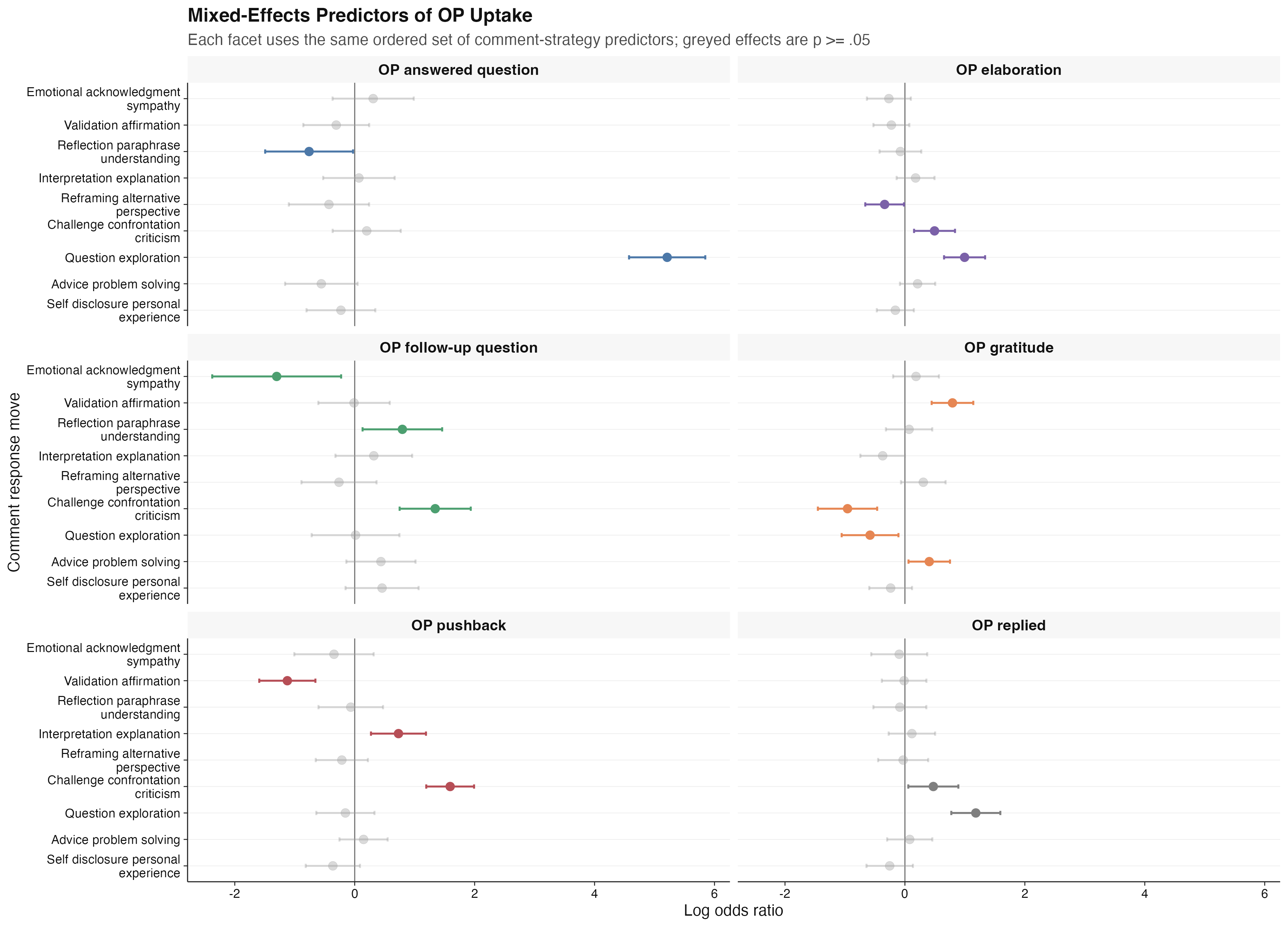
Questions predicted answering and elaboration; validation was associated with gratitude and lower pushback; challenge predicted pushback.
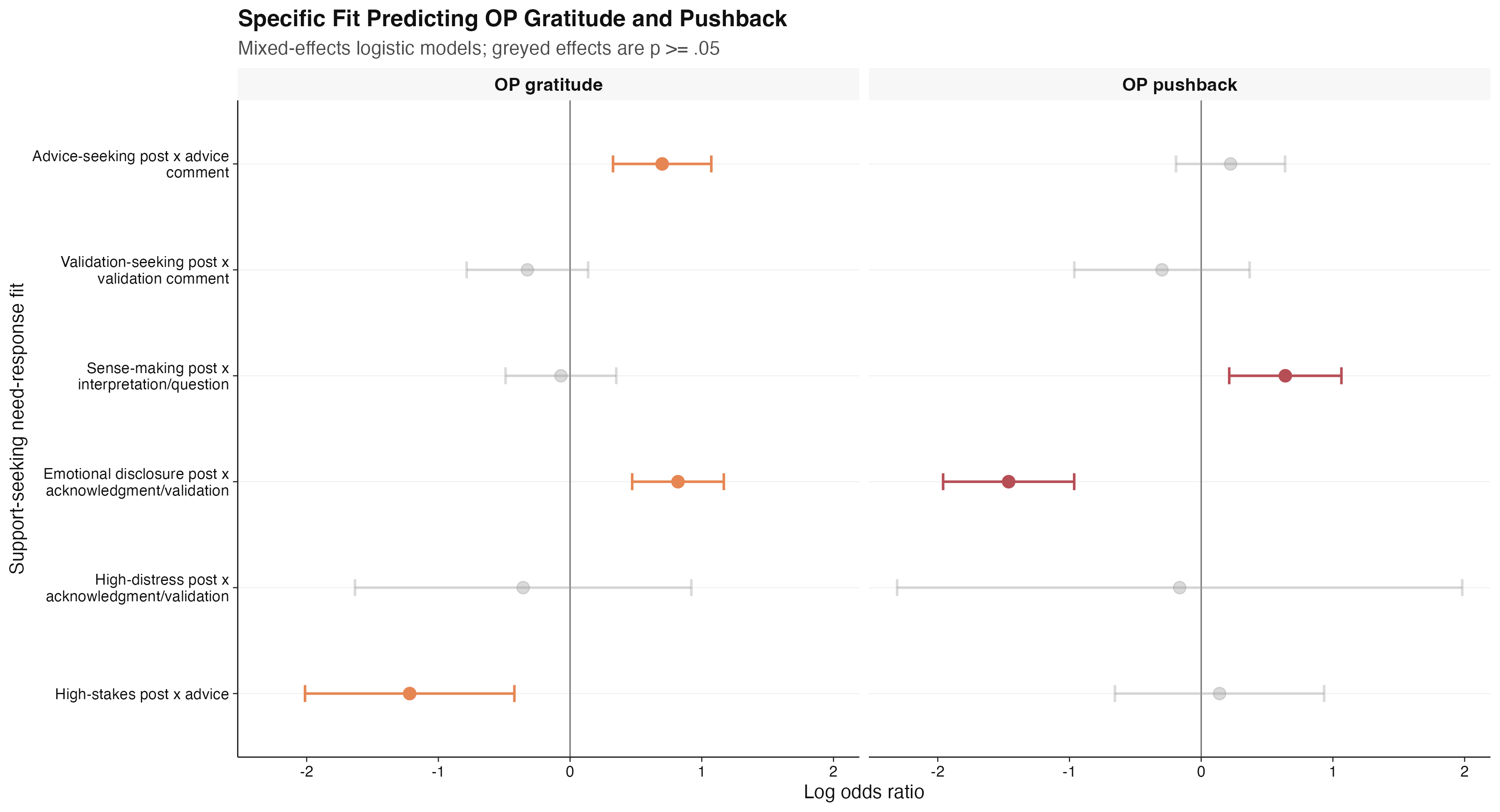
Specific forms of need-response fit were associated with how original posters replied. For example, advice-seeking posts that received advice and emotional disclosure posts that received acknowledgment or validation predicted more OP gratitude, whereas sense-making posts that received interpretation or questions predicted more OP pushback.
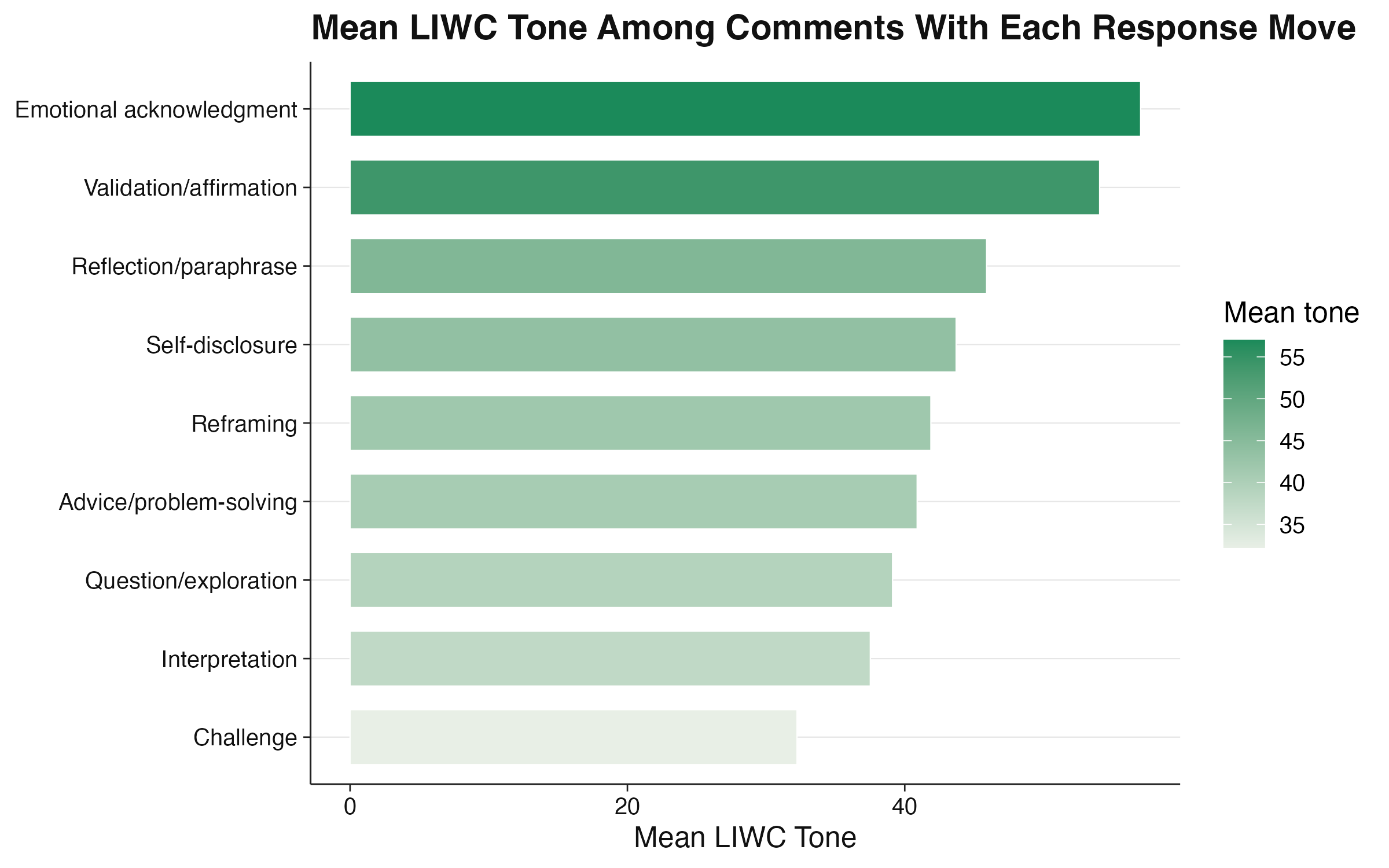
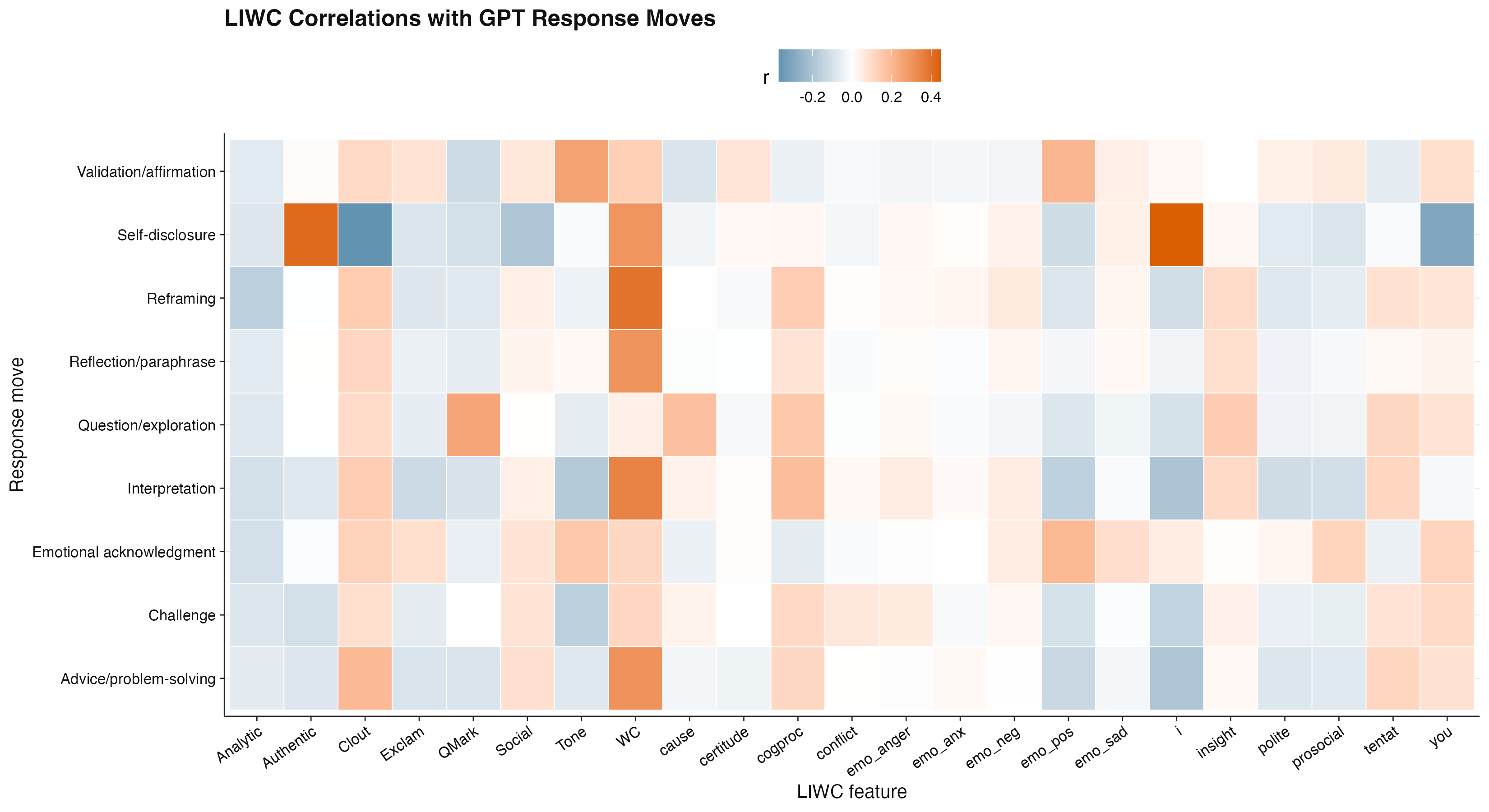
LIWC results showed that different response categories had distinct language profiles. For example, emotional acknowledgment, advice, questions, interpretation, validation, and self-disclosure differed in their overall tone, as well as the use of affective, cognitive, social, and self-focused words. This provides a descriptive check that the annotation labels capture meaningful differences in how people provide support.
Unlike past work, which tends to focus primarily on the support message and their effectiveness, the present project simultaneously models three components of online social support: what support-seekers ask for, what the commenter provides, and how the support-seeker. This makes it possible to study support fit rather than treating empathy as a stand-alone property of a single reply.
As a next step, I plan to scale the annotation to the full dataset after further validation. Additionally, the current dataset provides a useful human baseline for social support provision and can contribute to the evaluation of LLMs in providing goal-sensitive, calibrated social support in online settings.
Alghamdi, Z., Kumarage, T., Agrawal, G., Karami, M., Almuteb, I., & Liu, H. (2025). RedditESS: A Mental Health Social Support Interaction Dataset – Understanding Effective Social Support to Refine AI-Driven Support Tools. arXiv. https://arxiv.org/abs/2503.21888
Doré, B. P., & Morris, R. R. (2018). Linguistic synchrony predicts the immediate and lasting impact of text-based emotional support. Psychological Science, 29(10), 1716-1723.
Gueorguieva, E., Zhan, H., Suh, J., Hernandez, J., Lau, T., Li, J. J., & Ong, D. C. (2026). AI generates well-liked but templatic empathic responses. arXiv. https://arxiv.org/abs/2604.08479
Munin, S., Jurkiewicz, O., Gueorguieva, E. S., Oveis, C., & Ong, D. C. (2025). What can I say to help you? Language associated with successful extrinsic emotion regulation. Emotion.